How often should you recheck a regulatorlookup.org record?
Recheck a regulatorlookup.org record whenever the status matters, and use a set interval such as 30, 60, or 90 days only when the record is part of an…
How often should you recheck a regulatorlookup.org record?
Last updated: November 16, 2026
Quick Answer: Recheck a regulatorlookup.org record whenever the status matters, and use a set interval such as 30, 60, or 90 days only when the record is part of an ongoing decision. How often should you recheck a regulatorlookup.org record depends on whether you need a one-time snapshot or current evidence for later use.
Key takeaways
- A record check is not a one-and-done task if the status can change.
- The right rhythm depends on why you are looking: one transaction, an ongoing relationship, or a compliance review.
- Freshness matters more than habit. A record can be useful today and stale next month.
- Change triggers beat the calendar. A new filing, status shift, or update should prompt another look.
- If the result will support a decision, keep a dated note of when you checked it.
How often should you recheck a regulatorlookup.org record?
Recheck it whenever the record is still being used as evidence of current status. If you only needed a single lookup for a one-time choice, one check is usually enough. If the relationship, filing, or status can change later, a repeat check should happen before you rely on it again.
A practical rule is to think in three buckets. For a quick, one-off lookup, check once and move on. For an active situation that may change, check again at the next decision point. For a standing relationship, build a regular freshness review into your process, such as every 30, 60, or 90 days, based on how often the status can shift and how much risk is attached to being wrong. NARA and NIST both emphasize using records within a defined management process rather than leaving them to chance; see NARA records management guidance and NIST SP 800-53.
The page is most useful when the record is fresh. The less stable the status, the shorter the gap should be between checks. A dormant record can age quietly, but an active record tied to a filing or standing can change without warning from the user’s point of view.
The wrong habit is treating every record like it has the same shelf life. If the status is sensitive or time-bound, consult a professional or the relevant records owner before relying on an older lookup. That leads to wasted time on stable records and stale reliance on moving ones. A better rule is: check once for a snapshot, then recheck when the snapshot is old enough that it no longer answers the question you still have.
When is one check enough?
One check is enough when you only need a snapshot for a single decision and you will not rely on it after that decision is made. That is the cleanest case for a regulatorlookup.org record, because the record is being used as a point-in-time reference, not as an ongoing monitor.
A one-time lookup works best when all of these are true:
- the decision is immediate
- the record is not expected to change soon
- you do not need to prove ongoing freshness later
- there is no follow-up transaction, renewal, or review
If the answer will be filed away and never used again, a second check may add no value. If the answer will support an approval, onboarding step, or later audit trail, a single check can become weak fast. In that case, the real need is not more searching; it is a dated recheck policy.
For example, a record used to confirm current status before moving to the next step may only need one check if the next step happens the same day. If the next step happens weeks later, the earlier result is no longer a current answer. That is when a refresh matters more than the original search.
What changes mean I need a new check?
A new check is needed when anything about the record could have changed since the last time you looked. That includes a status change, a new update, a new filing, or any event that makes the old result less trustworthy.
The clearest triggers are these:
- the record shows a status that can move from active to inactive, pending, suspended, or similar
- the record is part of a process with deadlines or renewals
- the person or company has had time to file an update
- the old result was used for more than a short, same-day decision
- another source has already suggested the status may be different now
A new check is also smart after a meaningful delay. Even if nothing obvious has changed, time itself is a trigger because records do not age in a straight line. A 2-day-old result and a 2-month-old result do not carry the same weight.
If a record is tied to a gatekeeping decision, do not wait for a dramatic sign. Records often change quietly, then become important only when someone needs to rely on them. Consult the relevant professional or source of record if the status affects a regulated step, because a stale lookup can still look current at a glance.
How do I set a monitoring cadence?
Set the cadence by matching the check interval to the risk of stale status. A low-stakes, one-time task may need only a single lookup. A higher-stakes or ongoing use case needs a rhythm that keeps the record fresh enough for the decision in front of you.
Use this simple procedure:
- Name the use case. Write down why the record matters, such as one-time confirmation, monthly review, or an ongoing file. The result should be a clear reason to check, not a vague habit.
- Mark the decision date. Put the next date on a calendar, task list, or spreadsheet. A 30-day or 90-day review cycle works as a planning tool when the status can move.
- Tie the check to a trigger. Link the recheck to something concrete, such as a renewal, contract step, monthly review, or status review. That makes the lookup happen when it matters.
- Record the result and date. Save the current status, the date checked, and any update you saw. That keeps a dated trail for comparison later.
- Shorten the interval if the status is moving. If you notice updates more often than expected, move from a longer cycle to a shorter one. The next check should reflect real change, not wishful timing.
This approach is better than guessing at a universal schedule. A record that rarely changes does not need the same rhythm as a record that updates often. The goal is not constant checking; it is checking often enough that the record is still useful when you act on it.
The guide to using regulatorlookup.org for verification fits here, because this page is about timing, not first-time search steps. Once the first lookup is done, the next question is whether the record still deserves trust on the date you plan to use it.
How do I tell if a record is stale?
A record is stale when it no longer answers the question you need answered today. The age of the check is the first clue, but the real clue is whether the status could have changed since then.
Look for these signs:
- the check is older than your normal review window
- the status seems tied to a recent filing or update
- the decision you are making has moved to a new stage
- another source, document, or message points to a different status
- the record was checked before a deadline, renewal, or change date
Stale records cause two kinds of trouble. First, they can push you toward the wrong next step. Second, they can make you feel secure when the status may already be different. In practice, that means freshness review matters as much as the record itself.
The safe habit is to ask one question before you rely on the result: “Would I make the same decision if this status had changed yesterday?” If the answer is no, the record needs another look.
What is the cost of checking too often?
Checking too often costs time and can turn a useful process into busywork. If the status is stable, repeated checks can create noise without improving the decision. That is a real drawback, especially when a lookup is only needed for a simple, low-risk step.
The better cost is not just the minutes spent searching. It is also the mental load of watching a record that does not need constant attention. A 15-minute task repeated every few days can become wasted effort if nothing on the record is likely to move.
Still, the bigger mistake is the opposite one: checking too rarely and relying on an old result. That can matter more than the extra effort of a few unnecessary lookups. So the right cadence is a balance, not a guess.
A good rule is to start with the lightest schedule that still protects the decision. If the record turns out to be more dynamic than expected, shorten the gap. If it stays stable over several checks, lengthen the gap. That keeps the process practical without letting the record go stale.
Which timing rule fits each use case?
Different use cases need different recheck habits, and the right answer depends on how long the status must stay current. A one-time lookup, a recurring review, and a status tied to a deadline do not need the same schedule.
| Use case | Recheck timing | Why it fits |
|---|---|---|
| One-time decision | One check is often enough | The record is only needed as a snapshot |
| Ongoing relationship | Recheck on a regular cadence | The status may change before the next use |
| Deadline-driven step | Recheck before the next step | Old results lose value after the deadline passes |
| Higher-risk decision | Recheck more than once | Freshness matters more when the cost of error is higher |
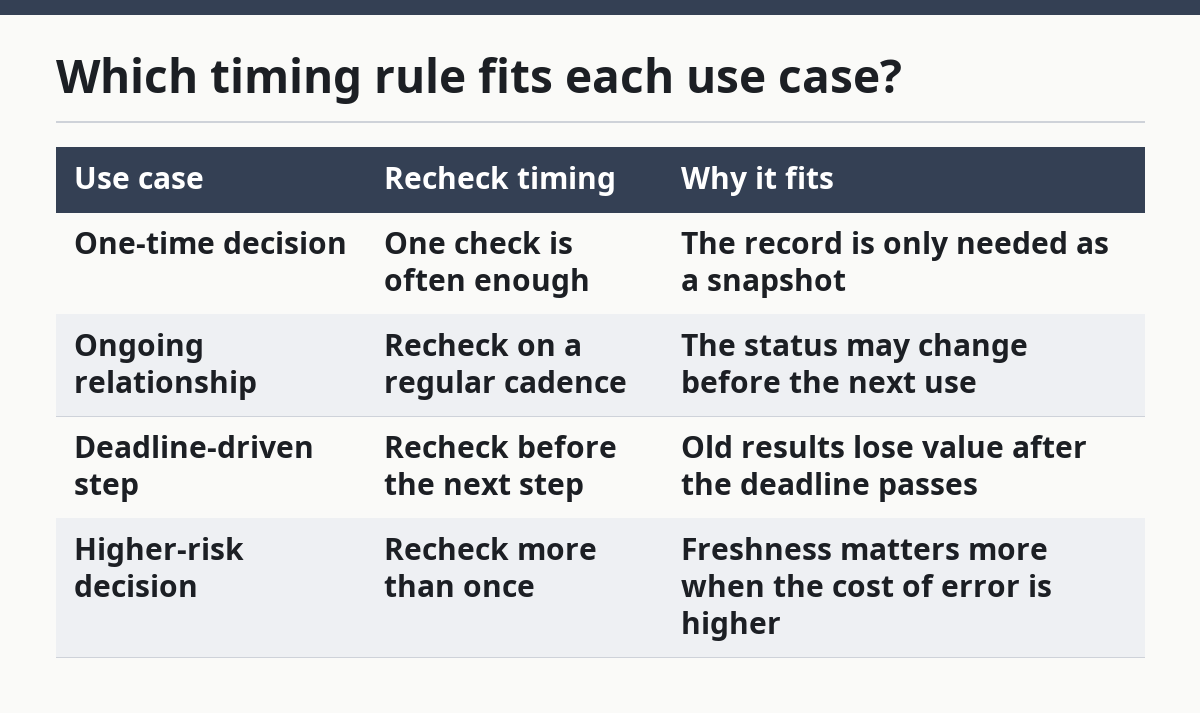
This table is not a rigid rulebook. It is a way to match the check to the job the record is doing. If the record is only there to answer a yes-or-no question once, a single lookup is fine. If the record supports an ongoing file, the timing has to be planned.
The real judgment call is whether the old result still counts. If it does, keep it. If it does not, run another check. That is the whole job of a recheck policy.
How should I review freshness over time?
Review freshness by comparing the last check date with the next time you need to rely on the record. If the gap is short, the old result may still work. If the gap is long, the record should be checked again before any decision depends on it.
A simple review method is to keep three dates: the date of the lookup, the date the status matters again, and the date of the next scheduled review. Those dates show whether the record is still fresh or already aging out of use.
Because freshness is part of the record’s value, treat it as part of the record, not an afterthought. A status is only useful if it is current enough for the task at hand. The more important the task, the shorter the freshness window should be.
If you want a practical next step, make the next check date part of the same note where you saved the result. That keeps the status, the update, and the review date together in one place instead of scattered across memory.
What changes mean I need a new check?
A new check is needed when the status could reasonably be different from the last time you looked. That includes a filing, an update, a deadline, a renewal point, or any other event that might have changed the record.
If the record is tied to a moving process, do not wait for proof that it changed. The fact that change is possible is enough reason to recheck when the old result is no longer fresh. If the process is quiet and stable, the same rule does not need to trigger as often.
A second check is also the right move when someone else will rely on the record next. A note from last month may have been fine for a private decision, but not for a new decision that depends on current status today.
The simplest way to think about it is this: no change in use, no rush to recheck; new use, new check. That keeps the process tied to the real question instead of the calendar alone.
When should I check again?
Therefore, check again when the record is still being used to make a decision and the last lookup is no longer fresh enough for that decision. A one-time snapshot does not need constant review, but a record that supports an ongoing step should be checked before it is used again.
What changes mean I need a new check?
Any likely status change is a trigger for a new check. That includes a new update, a filing, a deadline, a renewal, or a shift in the step you are about to take. If the old result could be outdated, it is time to look again.
Can a record update without notice?
Yes, a record can become outdated without any warning to the person relying on it. Even so, the safest move is to recheck before use when the status matters. A quiet change is still a change, and a stale record can still look current at a glance.
Drafted with AI; not yet reviewed by a person.
1 thought on “How often should you recheck a regulatorlookup.org record?”